Miss Norris
The Bell JarMiss Norris is a fellow patient whom Esther Greenwood encounters in the hospital, a quiet and enigmatic figure whose precise movements become the focus of Esther’s sustained attention. Her speechlessness is never explained, but her presence acquires a practical meaning for Esther: watching and trying to encourage her becomes a project that Esther hopes will earn privileges and help secure an escape. When the two patients are moved, their sharply different destinations expose the hospital’s classification of their prospects.
Arrival and First Impressions
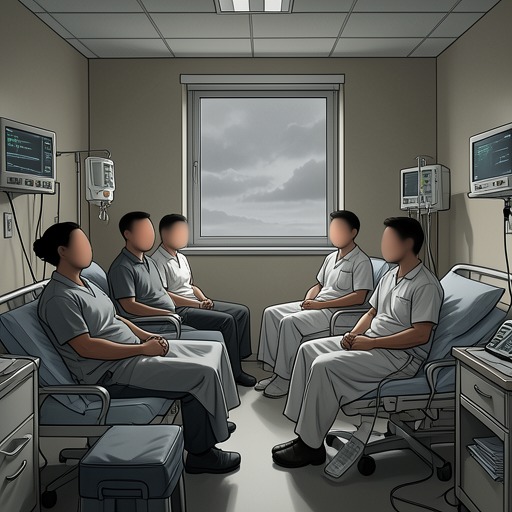
Miss Norris has only recently moved into the room beside Esther’s. Esther thinks that, as someone newer than herself, she may not yet know how ill Esther is, and imagines that this might make it possible to become friends. She finds Miss Norris lying on her bed in a purple dress fastened at the neck with a cameo brooch. The dress falls midway between her knees and shoes; her rusty hair is knotted in a bun, and thin silver-rimmed spectacles are attached to her breast pocket by a black elastic. These exact, contained details make her both vivid to Esther and difficult to know.
Esther sits watching her, wondering whether her pursed pink lips will open and what they might say. Miss Norris does not speak or look at her. Instead, she swings her feet, in high black buttoned boots, over the side of the bed and leaves the room. Esther reads the departure as a possible subtle attempt to get rid of her, but follows at a distance. The scene establishes the pattern that governs Esther’s interest: Miss Norris offers no explanation or invitation, while Esther observes, interprets, and waits for a response.
Ritualized Movement and Silence
Miss Norris’s movements strike Esther as unusually exact. On the way to the dining room, she places her feet precisely in the centers of the carpet’s cabbage-rose pattern. At the doorway she pauses, then lifts one foot and the other over the threshold as if crossing an invisible, shin-high stile. Inside, she sits at a round table and unfolds a napkin in her lap. The cook calls out that supper is still an hour away. The contrast between the ordinary dining room and Miss Norris’s deliberate crossing makes an everyday threshold appear to govern her movement.
The narrative gives no diagnosis or explanation for this behavior. Instead, Esther’s close attention turns Miss Norris’s silence and repeated gestures into the terms of their brief association. Esther watches her lips, follows her down the hall, and later measures the significance of the room and doorway Miss Norris must cross. Miss Norris remains a person whose inner life is inaccessible to Esther, not a source of information about her condition; much of what readers learn about her is filtered through Esther’s speculation.
Esther’s Vigil and Expectations
Esther’s interest soon becomes an all-consuming vigil. She refuses occupational therapy, walks, and badminton matches, and even gives up the weekly movies she enjoys, which Miss Norris never attends. Instead, she keeps watch by Miss Norris’s bedside, brooding over the pale, speechless line of her lips. Esther imagines how exciting it would be if Miss Norris opened her mouth and spoke, turning a hoped-for conversation into the anticipated culmination of her watching.
That anticipation is also bound to Esther’s own institutional circumstances. She thinks that if she can encourage Miss Norris to speak, the nurses will praise her; she may then be granted shopping and movie privileges downtown, and her escape will be assured. Her care and attention are therefore mixed with hope of advantage. The episode does not establish that Esther’s efforts change Miss Norris, or that Miss Norris knows what Esther expects of her. It shows instead how Esther makes a silent patient into the center of a plan for recognition and greater freedom.
Transfer and Diverging Prospects
When Esther is moved, she discovers that Miss Norris is being moved too. A young, cheerful nurse is helping Miss Norris into a purple coat with a thin squirrel-fur collar. Esther asks where she is going, but the nurse answers on Miss Norris’s behalf: Miss Norris is going to Wymark, and, the nurse says quietly, she is not moving up as Esther is. The exchange makes their different institutional trajectories explicit: Esther is being transferred to a sunny room in the front wing overlooking the green golf links, while Miss Norris is being sent to Wymark.
Miss Norris’s last movement in the episode repeats the image that has marked her earlier passage through the hospital. Esther watches her lift one foot and then the other over the invisible stile at the front doorsill. The threshold is not literal, but the gesture gives the transfer a visual conclusion: Miss Norris moves on with the same precise, solitary manner Esther has observed from the start. Her destination is reported by a nurse rather than by Miss Norris herself, leaving her own understanding and response unstated.
Narrative Role
Miss Norris functions as a contrast to Esther’s more active, self-interpreting struggle. Esther follows, watches, and invents possible meanings for the other woman’s silence; the narrative does not confirm those meanings. The mismatch between Esther’s imagined friendship and the absence of any spoken exchange preserves Miss Norris’s opacity, while revealing how strongly Esther wants companionship, approval, privileges, and a way out.
Her transfer also gives Esther an external measure of changing prospects. The nurse’s distinction between moving up and going to Wymark assigns the two women different places in the hospital’s hierarchy, even though Miss Norris herself has been presented through intimate observations rather than clinical explanation. The contrast is both concrete and limited: the scene establishes where each is being sent, but does not define Miss Norris’s diagnosis, history, or future. Her final crossing of the imagined stile leaves the figure Esther watched so closely still silent and unknown.